Sunday, September 18, 2005

2005 Festival Wrap-Up

Well, another festival done for the year.

Things that were done well:

  • The e-mail confirmations for advanced ticketing selection.
  • The volunteers did their usual excellent job of putting up with all the festival-goers, press, and industry.
  • I was surprised by the number of films in the last two days of the festival that had their director present for a Q&A. Granted, some of them are still looking for distribution, but it's nice when people don't immediately jet off right away after the first showing.
  • The new seats in the Ryerson theatre were nice, even if they didn't give much legroom.
  • The digital projection system used in a number of theatres looked really good. I thought Souvenir of Canada in the ROM looked incredibly vivid.

Things that could be improved:

  • The online ordering system and the festival web site cannot handle the amount of traffic generated on opening day of ticket sales. They either need to beef up their infrastructure or contract it out.
  • The festival should put a volunteer at the *end* of the lines during ticketing and more often at screenings to tell people what line they are in or should be in.
  • When picking up the film schedule and order forms, festival personnel should ask people how many coupon books they have so they can be given the proper number of forms.
  • The festival trailer; I think I heard and read more negative comments and jokes about this year's trailer than in any of the last 5 or so years of going to the festival. When even festival staff are shouting out "pull my finger", when journalists are actually *giving* the finger, and when there's even a photo of Jackie Chan looking like he's making fun of it, you know the trailer has been less than successful. I can understand that the festival would want an artistic trailer to fit their stature, but when you have to watch the same thing 26 times, it gets on your nerves.
  • Other trailers: not sure why AGF wasn't back as a sponsor this year, but their humorous ads before the movies are sure missed. The Visa ad was funny, but too bad it was only shown at the Elgin.
  • If you know who Stephen J. Mavilla is, you've watched too many movies at the festival. His short was funny, but couldn't they have picked a few people and do multiple shorts for the cell phone/piracy warning?
  • My friend commented that he liked the trailer thanking the volunteers better in previous years, when they didn't explicitly ask you to show your appreciation; it was better when the applause was a spontaneous reaction from the audience.
  • More transparency in the People's Choice Award voting. I've been reading a lot of comments on this year's winner of the award. Not that the film isn't deserving, but a lot of people seem to be saying they hadn't heard anything about it at the festival this year, so they are wondering why it ended up getting more votes than anything else. No one is quite sure how they tally up the votes and take into account the number of screenings, the size of the audience, the number of ballots collected for the movie, etc.

Interesting buzz/surprises:

Of the 26 films I watched this year:

  • Film I liked the best: Toss up between Winter Passing, La Vie avec mon pere, and Runaway.
  • Best Japanese Film: Linda, Linda, Linda. Takeshis' was just too impenetrable for me.
  • Best Canadian Film: La vie avec mon pere. Saint-Martyrs-des-Damnes and Lucid were a close second.
  • Biggest Guilty Pleasure: Banlieue 13. The chase scenes alone are worth the price of admission.
  • Best Romantic Movie: Opa! I thought the relationships and the characters in that film were better than those in Mistress of Spices.
  • Best Documentary: We Feed the World. But Sketches of Frank Gehry and Souvenir of Canada were also very good.
  • "WTF?!" Award: Tideland. But Takeshis' was right up there, along with A travers la foret.
  • Best Looking Film: Tie between Beowulf and Saints-Martyrs-des-Damnes.
  • Funniest Film: Festival. Although the Mavericks session with Nick Price was pretty funny too.

Thanks:

Note: most of my 2005 reviews (and some of the 2004 ones) are also available on the Internet Movie Database (http://www.imdb.com/) in the entry for each movie. Hope to be back next year with more festival stuff!

Gentille (Good Girl)

Gentille is the second feature film from Sophie Fillières, who both wrote and directed. Fontaine Leglou (played by Emmanuelle Devos) is an anesthesiologist in a private clinic. She has a scientist boyfriend (Bruno Todeschini) who is constantly trying to figure out how to get her to accept his proposal of marriage. But Fontaine is a bit adrift in her life, moving through a series of slightly absurd situations. She finds herself drawn to a patient in the clinic, a doctor (Lambert Wilson) who has to be induced into narcosis, and he may help her to define what she actually wants out of life.

This film is definitely odd, from the characters to the situations they encounter. Fontaine is a little bit scatterbrained and eccentric, challenging a man in the street who she thinks is following her then inviting him for coffee, or her reaction to an engagement ring hidden in her yogurt. The characters were a little too offbeat and odd, rather than quirky, for me to be completely engaged, and the interaction between Fontaine and her patient seemed rather peripheral. Emmanuelle Devos was kind of interesting to watch, and it was nice seeing Lambert Wilson in a dramatic role rather than in a Hollywood blockbuster, but overall the film never really clicked with me.

Obaba

Obaba is loosely based on Bernardo Axtaga's collection of short stories "Obabakoak", which won Spain's National Prize for Literature. Set in a fictional Basque town, Obaba follows Lourdes (Bárbara Lennie), a film student who has come to tape the town for a school project. She is soon drawn to some of the stories of the residents, all of which are told in flashbacks. These stories help Lourdes to understand the town, its people, and its secrets.

Montxo Armendáriz, who wrote the screenplay and also directed, has put together a fine film that blends the past and the present. Rather than use Lourdes simply as a device for prompting the villagers to tell their stories, she is an integral part of the movie. Lourdes is intrigued by the tales and the town's superstitions, and she soon begins to wonder if she has been caught up in and affected by it all. However, the film takes only a few of the stories from Axtaga's collection, and any political overtones don't seem to be present. The movie takes a more realistic tone and lacks any fantastical elements other than the mysterious blue-green lizards that seem to be indigineous to the area.

Festival

Directed and written by Annie Griffin, Festival follows a menagerie of characters at the Edinburgh Festival Fringe. Included are a young actress staging a one-woman show about Wordsworth's sister; a priest with a one-man play about abuse in the church; a veteran Irish comic who takes to sleeping with a radio critic to secure a long-overdue award; a trio of Canadians who seem to constantly be on a high; a famous and stuck-up comedian who is at the festival to judge a comedy award with his long-suffering assistant in tow. The movie follows each as they prepare and perform and succeed and fail.

Some of the stories and characters interact while others do not, but they all capture the comedy and drama and frenetic backstage energy of a festival so huge in scope it encompasses everything from stand-up to experimental performance art. Some of the stories are played for laughs, others have a more serious tone, but each is engaging in its own way. The story with the priest might have a bit too much pathos, though. The cast is uniformly good and overall the movie was very entertaining.

Runaway

Runaway follows two brothers, Michael (played by Aaron Stanford from Tadpole and X2) and his younger brother Dylan (Zach Savage) who have moved to a small town. Michael has taken a job in a roadside gas station, while Dylan spends his time playing alone in their motel room. In flashbacks and letters to his psychotherapist, it soon becomes apparent that Michael has taken Dylan to escape from their parents, played by Melissa Leo and Michael Gaston, for reasons that are soon revealed. While Michael is trying to lay low, his growing attraction to his co-worker Carly (Robin Tunney) and his own ever-present demons seem to be jeopardizing his attempt to start a new life for him and his brother and leading the film to an explosive conclusion.

Runaway is a surprisingly good film, that features great performances from Stanford and Tunney. They and the script from screenwriter Bill True help to elevate what could have been a conventional film into something more substantial and emotional. The film does not yet have distribution, but hopefully someone will pick it up so that a wider audience can enjoy and appreciate it.

Director Tim McCann, screenwriter Bill True, and producer David Viola were in attendance at the screening and did a Q&A after the film:

  • The film was made a year ago in Catskill, NY, and took about six months to complete.
  • The script ran around about 95 pages, which is relatively short. They workshopped the script with the actors, and developed the material as they went along. They ended up cutting about 15 minutes or so to arrive at the final cut.
  • The story originally came from a short story that screenwriter Bill True wrote in 1998,
  • They saw about 35 boys for the role of Dylan during casting. Zach Savage had a photographic memory of the script. Tim McCann's direction for him was basically "say this line, wait five seconds, say the next line." But as an audience member commented, the performance that came out seemed very natural.
  • On casting: McCann knew Melissa Leo from directing an episode of Homicide: Life on the Street. Terry Kinney (who plays Michael's psychotherapist in the film) came on board at Robin Tunney's suggestion. McCann and Tunney are friends. Michael Gaston was the best out of the 5 or 6 actors who they looked at for the father.
  • Producer David Viola suggested Aaron Stanford just after Tim McCann came on board as director. McCann thought he was a question mark after seeing Tadpole, but after sitting down with him, knew that he was right for the role.
  • The characters of Michael and Dylan were originally younger, but they shifted the ages after casting the actors.
  • A marquee the characters pass in the film actually features one of McCann's earlier films.
  • This is the first produced screenplay of Bill True. Just last Monday (September 12, 2005) he turned in the draft of his next script, The Angel on the Horse, which they hope to start shooting in early 2006.


Potential major spoilers below. Stop reading if you do not want to know anything about the end of the film:


  • True and McCann did a lot of research for the movie (True has a relative who is a paranoid schizophrenic). Michael suffers from disassociative disorder that comes on through extreme mental trauma, and people forget certain events in their lives. True talked to a few psychologists who have all said it is plausible.
  • McCann talked to some psychologists because what interested him is whether or not our behaviour is determined by our experiences or by what genetically our character and personality is. Can we triumph over our experience or a disease/mental illness? He also wondered whether post-traumatic stress could be triggered by further trauma later on, that could induce a psychotic break.

Frankie

Frankie is the feature film debut of Fabienne Berthaud, who both directed and wrote the screenplay. The film follows Frankie, a fashion model played by Diane Kruger (Troy, National Treasure). The movie jumps back and forth between Frankie's past in the high-flying world of fashion, and the present, when Frankie is in a private clinic after having a breakdown. What seems like a glamourous job is revealed to be moments of action in between long stretches of boredom and loneliness, filled with shallow characters who treat the models more as clothes hangers than people. Only the modeling agency's driver who shuttles Frankie around from job to job seems to have any real empathy for her. Frankie's time in the clinic gives her the opportunity to reflect back on her life and what she wants for the future.

The film has an intimate documentary-like feel, aided in part by Berthaud's use of a single digital camera. There is relatively little dialogue or story beyond documenting moments in Frankie's life. This style might not be for everyone, but it lends a feeling of realism to the images on screen. Diane Kruger gives a very good performance, light years away from her roles in bigger budget Hollywood pictures. She conveys a sense of weariness with the world and the meaninglessness of her life simply through her actions and posture.

Director/writer Fabienne Berthaud was in attendance and did a Q&A:

  • The film was shot over a three-year period, in bits and pieces. At the start, Diane Kruger wasn't well known as an actress. The original producer did not want her in the film for that reason, but Berthaud persisted, even to the point of losing her financing. As a result, she bought a camera and decided to do the film on her own. Eventually Kruger started getting cast in Hollywood films, but she still came back between movies to shoot her scenes for Frankie.
  • The film was shot for about 3,000 Euros.
  • Berthaud had previously done a documentary on the fashion industry, and thought that it was an interesting subject to show what works in society and what doesn't.
  • Berthaud has a background as a novelist, and that the relatively short screenplay is a skeleton on which to hang the performances and the film.
  • There was a fair bit of working on the fly, as she had to work with a number of real people with mental issues at the clinic. This meant she had to use the camera as a pen, often going along with what unfolded on screen.
  • Whether working on films, photography, or writing, it is simply changing tools for her.
  • The film had just a crew of three; Berthaud did the camera and lighting, and she had an assistant and a sound engineer, and that was about it.

La Vie avec mon père (Life With My Father)

La Vie avec mon père is the second feature film from director and co-writer Sébastien Rose. The film recently won the Audience Award at the Karlovy Vary International Film Festival in the Czech Republic. In Rose's own words, the movie is about "patrimony and brotherhood, and what we leave behind when we die." La Vie avec mon père follows two brothers, Patrick (David La Haye), a high-powered executive at a pharmaceutical company, and Paul (Paul Ahmarani) a writer who seems to spend most of his time slacking off and selling what ever drugs he can steal from his brother. The reappearance of their famous writer father François (Raymond Bouchard) in their life soon throws everything into turmoil. For various reasons, all three of them, along with Paul's free-spirited girlfriend Sylvie (Hélène Florent) are soon thrown together in François' dilapidated house and they are forced to examine their feelings and relationships.

La Vie avec mon père walks the line between comedy and drama, but walks it well. François is played to great effect by Raymond Bouchard, who has to portray an aging lothario who must come to terms with his failing body. Both David La Haye and Paul Ahmarani are good at playing the brothers who are polar opposites, but who still ultimately share a love for their father and each other. And Hélène Florent is wonderful as Paul's girlfriend, who seems to know each other characters better than they know themselves. The story is very good and heartfelt, and there are a lot of touching moments that don't cross the boundary of being overly sentimental.

Director Sébastien Rose did a Q&A session after the film:

  • As a filmmaker, he prefers to asks questions, not give answers in his films.
  • The house used in the film is in Outremont, in Montreal. Rose spotted the house while filming his first feature, but couldn't do anything with it given the budget he had at the time. The house had to be seriously distressed to make it fit in this film.
  • The movie was released in Quebec last spring, and now they are taking it on the road; they've been to the Czech Republic, and plan to go to Belgium.
  • The film is not autobiographical for Rose, but is personal in its style and motifs. The film is very personal for the other co-writer, Stéfanie Lasnier.
  • Any similarities to Les Invasions barbares (The Barbarian Invasions) is unintentional. They were actually filming and watching the Oscars on a monitor when The Barbarian Invasions won the foreign film Oscar. Rose said that the whole question of fathers and their legacy is in the air, that the whole issue of identity in Quebec makes the question of the father very important.
  • Patrick's wife in the story is not really very important; she is more just a way to characterize Patrick. The story is really about the two sons coping with the return of their father in their lives. The dogs that live in François house are also just a way to characterize Paul and François, that they are both cool and eccentric.
  • Sylvie is a portrayal of all women, or the ideal woman, and in fact most of the male characters see her in that way.
  • The house in the film represents the body of the father. When the pipes burst and water is flowing everywhere, it suggests the decay of the body.
  • It was important to show François losing his dignity; Rose said it is the ultimate expression of death.
  • Rose had operatic arias in mind for François, as his characters is bigger than life. But personally, he felt there was perhaps too much music in the film. Originally, when editing, he didn't have any music, to make sure the scenes worked on their own.
  • Rose feels that he's done with the family question, and that his next film will be more poetical and political, and bigger in the sense that it will be about more than a small circle of three characters.
  • The lighting was very specific to the mood in the film; before Christmas, the lighting is very warm and yellow; after Christmas, it becomes more white and more realistic, like the white light at the end of the tunnel.

Mistress of Spices

Mistress of Spices is based on the novel by Chitra Banerjee Divakaruni, and is the directorial debut for Paul Mayeda Berges. Berges has worked previously with his wife, Gurinder Chadha, on a number of films including Bend it Like Beckham and Bride and Prejudice. Chadha co-wrote the screenplay here with her husband.

The movie follows Tilo, played by Aishwarya Rai, who is a member of an old, mystical cult that worships spice in all its forms. She is sent to Oakland to open a shop and help people using the mysterious powers of the spices. Tilo, who also has the power to see visions of the future, soon ends up helping a whole coterie of characters: a man (Anupam Kher) who is distressed over his granddaughter (Padma Lakshmi), a woman who has grown up in America and adopted western ways, much to his dismay; Jagjit (Sonny Gill Dulay), a teenager who is having trouble with the kids at school; Haroun (Nitin Chandra Ganatra), a cab driver that has a cloudy future; Kwesi (Adewale Akinnuoye-Agbaje), a man trying to win the heart of a woman.

But to be successful, Tilo must follow three rules: one, she must never leave the store; two, she must never touch the skin of another person; three, she can never use the spices for her own gain. One day a man (Dylan McDermott) falls off his motorcycle outside her store and they are both instantly drawn to one another, challenging Tilo's devotion to her cause and threatening her control over the spices.

This is a nice, light film, reminiscent in many ways of Chocolat, with Aishwarya Rai in the Juliette Binoche role. Rai is luminous on screen, and the chemistry between her and Dylan McDermott is good. I didn't think the voice-over narration of Rai's character's inner thoughts was entirely successful, although I can't see how else you could really do it; funny enough, the voice-overs reminded me of another spice-related movie, David Lynch's Dune. The movie explores a bit of the mixing between east and west and the conflict between old and new, but not quite as successfully as some of Berges' and Chadha's other films, but that is probably due more to the limitations of creating an adaptation, and the fantastical nature of the story.

Saturday, September 17, 2005

Beowulf and Grendel

Beowulf and Grendel is based on the Old English epic poem of the same name. It follows Beowulf, a Geat, who travels with his compatriots to Denmark and the realm of King Hrothgar (Stellan Skarsgård), which is besieged by a great monster, Grendel (Ingvar Sigurdsson). Beowulf repeatedly tries to draw Grendel out to do battle, but soon finds from the witch Selma (Sarah Polley) that there may be more the story than meets the eye.

Historical purists will probably take issue with the portrayal of the story and with the dialogue. However, judged on its own merits, Beowulf and Grendel is a fine film. The film looks epic, thanks to the on-location filming in Iceland. Gerard Butler is suitably heroic, and Ingvar Sigurdsson does well with a role that has essentially no dialogue, what with being a sub-human troll and all. Screenwriter Andrew Rai Berzins makes use of slightly more contemporary language in the script, but without any ill effect. Director Sturla Gunnarsson has made some interesting casting choices, with Scots actors as the Geats (who are actually from Sweden), Nordic actors as the Danes, and Canadian Sarah Polley as Selma. The cast acquits themselves well, including Polley, whose Canadian accent serves to show her character's isolation from the rest of the community.

Director Sturla Gunnarsson, screenwriter Andrew Rai Berzins, and actor Tony Curran did a Q&A after the film:


  • They took a lot liberty with the story, especially as the poem has speeches that go on for pages and which would be unfilmable. They decided to cut loose from it right away, and instead portray the story that would become the poem. As Gunnarsson put it, they tried to be true to "the bones of the story." Since the poem dates back to a Norse oral tradition, where poets would embellish stories with each telling, Gunnarsson felt they could do some of the same.
  • There were a number of problems during filming, as they started shooting several months later than planned. At the time, there were a lot of hurricanes in the Atlantic, which results in very high winds. They lost four base camps, and in a single day lost eight vehicles to the 150 km/h winds.
  • The ship used by the Geats is actually the Islendingur, a replica of a Viking ship from 870 AD, originally built to commemorate the anniversary of Leif Ericson's voyage to North America. The boat leaked, so four fire pumps were required to keep it afloat. However, for long shots of the boat in an iceberg-filled lagoon, the pumps had to be shut off and footage gathered quickly.
  • Grendel is supposed to have the strength of 30 men, but at the same time he is not a god, which it makes hard to portray him on screen. They didn't want to create a fantastical movie, so they decided early on not to use any CG for Grendel.
  • The horses used in the movie are Icelandic horses, which have three gaits unique to the breed. These gaits are uniquely suited to travel over the rocky terrain.
  • The palette for the costumes if taken from the landscape. Silk was used for the costumes instead of cotton, simply because it hangs better on the actors.
  • When casting Beowulf, they wanted someone unambiguously masculine, who could act, and who could bring some complexity to the role. Gunnarsson had seen some of Gerard Butler's films. While they weren't his cup of tea, he did find that Butler jumped off the screen.
  • Gunnarsson and Sarah Polley have known one another for years. She loves Iceland and had asked to be cast in whatever he decided to film there next. Gunnarsson feels that Polley brings something to the moral conscience of the story.
  • For Grendel, Gunnarsson had consulted with creature makeup director Nick Dudman, who has also worked on the Harry Potter films Dudman said that he could build prosthetics, but it would really all come from the actor.
  • Ingvar Sigurdsson read the script and was drawn to Grendel without any prompting from Gunnarsson. While in a bookstore in Reykjavik, an American tourist noticed that script and recommended John Gardner's book Grendel, which tells the story from Grendel's perspective.
  • They weren't originally allowed to cast Stellan SkarsgÃ¥rd as he is not from the UK, Iceland, or Canada. On appeal to the UK authorities, they eventually agreed that it would be all right for a Norseman to play another Norseman.
  • They wanted the Geats to look like a gang of bikers, not some sort of museum piece.
  • On the use of humour in the script, Berzins said that there is humour in everything, and that he is frustrated by historical movies with no humour.
  • Berzins said about the use of the f-word in the movie that the f-word is actually quite old, but he does realize that some people are brought forward in time when they hear it. SkarsgÃ¥rd was originally not a fan of its use, but by the end he was using it quite liberally.

Spoilers below:


  • They tried to stay close to the story, but in the original, none of the characters have much in the way of motivation; Grendel just shows up and starts killing people. They felt that either he's simply evil, or he has a reason, which opens up all sorts of possibilities.
  • They felt that this is a good time in history to explore the hero-myth. Beowulf is essentially a story about a warrior that goes overseas to fight a righteous quest but soon finds himself embroiled in a tribal war.
  • Tony Curran said that his favourite scene is the one where the young Grendel is holding his father's severed head. Berzins' favourite is the one where Tony's character destroys Grendel's father's skull, he looks up, and you can see doom descend on him. Gunnarsson's favourite is SkarsgÃ¥rd's disintegration at the end when he explains the cause of everything and that his kingdom has been destroyed by a meaningless act.
  • Ingvar Sigurdsson's 4-year old son is in the film. The Q&A implied he played the young Grendel, although the IMDB appears to credit him as Grendel's son.

Closing Awards

The festival announced awards for the festival. The People's Choice Award went to Tsotsi, from Gavin Hood, about a gang member in South Africa who finds a baby in a car he has just carjacked. This year, rather than voting for only one film for People's Choice, people were asked to rate each film on a scale from 1 to 5, 5 being best.

The Discovery Award, voted on by the international press, went to Look Both Ways, from Sarah Watt. The film follows three characters handling various crises in their lives after a train wreck.

The FIPRESCI (the International Federation of Film Critics) Prize went to Sa-kwa, from Kang Yi-kwan. In the movie, a woman impulsively jumps into a relationship after being dumped by her fiancé. The prize is awarded by a jury consisting of three film critics.

The Citytv Award for Best Canadian First Feature went to Familia, from Louise Archambault, and The Life and Hard Times of Guy Terrifico, by Michael Mabbott. Familia is about two women and their daughters. The Life and Hard Times of Guy Terrifico is a faux documentary about a fictional country music star, but features actual music legends talking about the titular character. The award is voted on by a jury.

The Toronto - City Award for Best Canadian Feature Film went to C.R.A.Z.Y. from Jean-Marc Vallée. The film follows a family in 70's Montreal. The award is voted on by a jury.

The previous two awards were both voted on by a jury, including director and producer Ron Mann (Go Further).

The Bravo!FACT Short Cuts Canada Award went to Big Girl, by Renuka Jeyapalan. The short is about the struggle between a young girl and her mother's boyfriend for her mother's attention. The award is voted on by a jury, which included Rachel McAdams (The Wedding Crashers, Red-Eye), and director Rob Stefaniuk (Phil the Alien).

The complete story can be found at:

http://www.e.bell.ca/filmfest/2005/mediaCentre_releaseItem.asp?id=184

Remaining Reviews

The final 8 reviews will appear late Saturday or on Sunday. Had four films on Friday, and have another four on Saturday, starting at 9:00 AM, so I'm a little behind. Personally, I don't know how anyone has the stamina to do 50 films; I'm getting burnt out after 20!

Celebrity Sighting 6

Director Sturla Gunnarsson outside the screening of Beowulf and Grendel:

Thursday, September 15, 2005

Mavericks: Nick Park

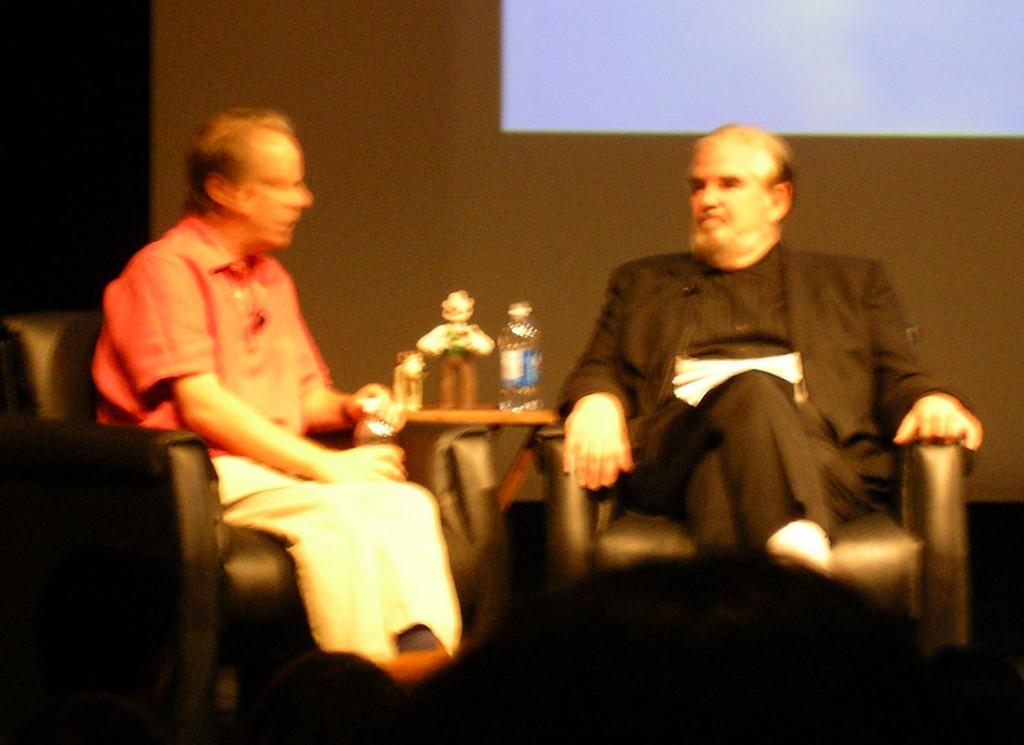
The Mavericks program was set up by the festival to allow filmmakers and other industry people to talk about movies in an interview/Q&A format. This is the first year that it has been open to the general public. I managed to get a ticket for the session with Nick Park, creator of Wallace and Gromit. Wallace and Gromit's latest adventures are featured in the film Wallace and Gromit: The Curse of the Were-Rabbit, which is screening at the festival this year. Park showed the actual models of Wallace and Gromit that were used in the latest movie.

Richard Corliss, a columnist with Time magazine since the 80's, interviewed Nick Park:

  • At the age of 12 Park was into drawing cartoons and playing with plasticene.
  • His parents had an 8mm Bell and Howell camera that had an animation button on it, and he used it to experiment with clay and cut-outs.
  • At 15, Park had a film shown on the BBC.
  • He made about half-a-dozen to a dozen films at home on his own, and cited Terry Gilliam as an influence.
  • While at the National Film and Television School, he first had an idea for an animation featuring a man building a rocket in his basement. In sketches, Wallace has a moustache, and Gromit has visible teeth.
  • Originally, Gromit was supposed to be a cat, but Park found it far easier to model a dog. Also, he felt there was a good dynamic in the man/dog relationship. He likes to think of the two as an old married couple.
  • Penguins show up frequently in work by both Park and Aardman Animation. Park says he has nothing against them, but wanted a villian different than anything seen before.
  • Park worked summers at Aardman, and eventually founders Peter Lord and David Sproxton convinced him to come on board full time if they helped him to finish Wallace and Gromit, which he had been working on for three years at school.
  • One of the first projects Park got to work on at Aardman was the video for Peter Gabriel's Sledgehammer. They only had a week to do the video, and Gabriel wanted it to look like a 14-year-old kid did it in his attic.
  • Much of the video was shot with a camera mounted looking down at the floor. One of Park's main contributions was a bit involving actual raw chickens, which scared him at the time, as there was a salmonella scare in Britain at the time. The MP who created the scare and was later forced to resign was named Edwina, and her name was later given to the chicken in Chicken Run that gets her head cut off.
  • Park's sister, now a painter, had a pet chicken when they were young. It had an imaginary boy friend she called the "lone free ranger" which made it into Chicken Run in the form of Rocky.
  • Further on the chicken theme, when Park was about 17 or 18, he worked in a chicken packing factory. He spent a day in the slaughterhouse, and the machines in there would later give him inspiration for the pie-making machine in Chicken Run.
  • For his next project, Park had the idea for recording conversations of people at the zoo talking about animals, and then turning it around, pretending the conversations were actually animals talking about people. Unfortunately, simply recording conversations proved to be uninteresting, so Park turned to actually interviewing people. This project became "Creature Comforts", which later went on to win an Oscar for best short film, ironically beating out the film which took him longer to make, Wallace and Gromit's A Grand Day Out.
  • At the Oscar ceremony, Park had written two lists of thank-yous, one for each film, and was afraid he was going to end up thanking the wrong set of people.
  • The BBC wanted a half-hour Christmas special featuring Wallace and Gromit, which led to the short, The Wrong Trousers. It took about six months to storyboard, and 13 months to shoot. Bob Baker shared writing credits on the film; Baker was also a script editor for Doctor Who.
  • The name for Gromit apparently came from the term for a bit of insulation that his electrician brother used.
  • Park has never had a dog, so Gromit is not based on any real life dog. Instead, Gromit is sort of the dog Park has always wanted but never had.
  • Shortly after finishing A Grand Day Out, Park realized that Wallace was a lot like his father, who was forever building things in the shed. He once built a caravan from the wheels up, and even wallpapered the inside, just like Wallace did with his rocket. Park's father was a photographer by trade, but loved to make things.
  • Park likes using plasticene because it can give such subtle movements and expressions, and there is an immediacy to it.
  • They put animators through Wallace and Gromit classes to ensure they know how to move both characters; for instance, when Gromit moves his head, his nose should go down like a human, not up like a dog.
  • Steve Box, who Park has worked with on a number of projects, really understands the psyche of the characters, which is why Park wanted him on the latest film. That film has about 250 crew, with 30 animators. There are also 30 sets.
  • They idea for The Curse of the Were-Rabbit came just before or during the filming of Chicken Run. It was about 5 years in the making, and took 2 years to film.
  • Aardman has a five-picture deal with Dreamworks. Another film will be released next year, and is actually done with CGI, but they are still planning on doing more clay movies. The movie is about rats in the London sewers.
  • Park has heard that model animators make good CG animators since they are already used to thinking in three dimensions.
  • One scene in The Curse of the Were-Rabbit was done partially with CGI because what is shown would have been impossible in clay.
  • Amongst CGI animation, Park admires Madagascar and Pixar movies, especially The Incredibles, but he doesn't like when CG goes its own way, to complete naturalism with no design decisions being made.
  • Park misses animating a lot; he didn't do any on the latest film.
  • About a 1/4 to a 1/3 of the animators on the latest film are women.
  • They can't really have key frames in stop-motion animation, but they do do rehersals, blocking through scenes especially since the cameras are computer-controlled. The animators often act out the scene on video to use as a guide.

Linda Linda Linda

Linda Linda Linda is set in a high school in Japan and follows a group of girls who have formed a group to sing one of their own songs for a school festival. The guitarist injures her hand in gym class shortly before the festival, but rather than give up, three of the girls, keyboardist Kei (Yu Kashii), drummer Kyoko (Aki Maeda) and bassist Nozomi (Shiori Sekine) decide to reform and cover songs by Japanese 80's punk group The Blue Hearts. Kei takes over guitar, but short of a vocalist, they take the first girl that walks by, who turns out to be Korean exchange student Son (Bae Doona). Son can barely speak Japanese, but nevertheless, the four girls press on and practice long into the night for three days straight to get ready for the festival.

Linda Linda Linda is a funny and entertaining film, and captures the atmosphere of high school days. The girls forge new friendships and explore first love with boys while still madly practicing for the big day. Bae Doona has some really hilarious moments as Son, but all the girls are fun to watch from the time they start as a musical mish-mash to the finale when they step up on stage. And you won't be able to get the refrain of "Linda Linda, Linda Linda Linda" out of your head for days.

Linda Linda Linda was directed and co-written by Nobuhiro Yamashita, and James Iha of Smashing Pumpkins fame provided the score for the movie.

Celebrity Sighting 5

Nick Park (Wallace and Gromit, Chicken Run) being interviewed by Richard Corliss of Time Magazine. On the table are the actual models of Wallace and Gromit used in their latest film, Wallace and Gromit: The Curse of the Were-Rabbit. Apologies for the poor picture quality, but that's why I'm in computers and not photography:

Jazireh Ahani (Iron Island)

Iron Island is the second feature film from Iranian director Mohammad Rasoulof, who also wrote the screenplay. Iron Island refers to an old, abandoned oil tanker floating in the Persian Gulf, populated with all sorts of people and presided over by Captain Nemat (Ali Nasirian). The ship is a miniature city, with its own school and barter economy, and Nemat is constantly running about, seeing to the needs of the people under his protection, while at the same time overseeing the gradual disassembly of the ship for scrap metal.

The ship contains a whole coterie of characters, including the young man Nemat adopted who is in love with a girl betrothed to another man; the old man who is constantly looking out into the distance for who-knows-what; the young boy who is trying to rescue fish from the hold and return them to the ocean; the teacher who insists the boat is slowly sinking. Under threat from the authorities to abandon the ship, Nemat must decide what to do to keep his little city together.

The film was enjoyable, and it was fascinating to watch the society that Nemat had built up on his own little floating island. The characters were absorbing to watch, especially Nemat, who seemed to be partially motivated out of love for his charges, and partly because he wouldn't know what to do with himself if he wasn't leading the people.

Director Mohammad Rasoulof attended the screening and did a Q&A:

  • The film is about the isolation and loneliness of a society, but one that still has a beautiful life.
  • The story is purely fictional.
  • Nemat disconnects the people from the outside world from the moment they arrive, resulting in the people willing to follow or do whatever the captain wants. When a society is completely cut off from the outside, whatever is left rules you.
  • The film has not yet screened in Iran; they are currently waiting permission that has been promised to them.
  • Every film, poetic or not, goes back to the filmmaker and what they want to say; and this film is what Rasoulof wants to say.
  • Any artistic work has many different layers, with the plot/story being the one on top. The same thing happens in different places, not just one society. The film is not a metaphor for Iran in particular.
  • The script was originally written as a theatre piece 10 years ago. Rasoulof rewrote it two years ago, and put the ship as a character in it.
  • The cast and crew of about 350 had to commute 10 km a day to the ship.
  • The people in the area where filming took place are very religious and were uncomfortable with the idea of being in a film, so Rasoulof had to go to an area about 60 km away, where many of the people had emigrated from elsewhere, for his cast.
  • Ali Nasirian, who plays Captain Nemat, is a renowned actor in Iran, and did a lot for the film.
  • Each one of the characters in the film is based on someone Rasoulof knows. The little fish boy is based on his own childhood and that of his brother. The man watching the horizon is someone Rasoulof remembers from growing up. The teacher is someone he knows well.
  • The idea for the ship just came to Rasoulof, and he wasn't sure how. He just said there are times one is inspired by such ideas.
  • There is one scene when the older boys are watching satellite TV. The TV was originally supposed to be playing Titanic, starring Leonardo DiCaprio, but they couldn't get the copyright to do so.
  • On the issue of censorship, Rasoulof said he basically made the movie he wanted to, and let the censors excise what they wanted.

Spiele Leben (You Bet Your Life)

Directed and written by Antonin Svoboda, You Bet Your Life stars Georg Friedrich as Kurt, a compulsive gambler who wants to do only that; he shirks all manner of responsibility, with his girlfriend, with the various jobs he drifts through, and with his father. One night he has a chance meeting with an older woman in a bar, and they bond over a video slot machine. They soon find themselves in a casino, where she proposes using one of her earrings that are a pair of dice to determine what numbers they should bet on at the roulette table.

This eventually leads Kurt to decide to base his entire life on a roll of the die. He soon turns away from his girlfriend and meets Tanja (Birgit Minichmayr), a sexy but rough drug addict, whom Kurt brings into his little game. Any successes in the casino are soon balanced by failures in the rest of his life which threaten to bring everything to a crashing halt.

You Bet Your Life is an interesting film, and Friedrich and Minichmayr have a fiery on-screen relationship. The only problem I had with the movie, and this may be due more to my own inattention, was with the latter half of the film, which is actually structured as six separate story lines, where Kurt mulls over different choices he could make when he and Tanja pull up to the gas station. Because the first choice or two take up so much screen time, it didn't seem readily apparent that each time the car pulls up to the gas station, a different choice is being shown. Had I realized that sooner, I think I would've appreciated the film more while I was watching it. In retrospect, though, the film gives an intriguing take on chance and fate and making choices in life.

Director Antonin Svoboda attended the screening and did a Q&A afterwards:

  • Svoboda has one friend who is a gambler, who he used as the object of the story (although he doesn't use dice like Kurt does).
  • Svoboda had followed the career of Georg Friedrich for several years, and wrote the story especially for him, so he could see Friedrich in a lead role rather than the many side roles he has played.
  • The main inspiration for the film was Dostoyevsky's The Gambler, and to a lesser extent, The Dice Man by Luke Rhinehart. Svoboda was always surprised by the end of The Gambler and what happens to the main character. For The Dice Man, Svoboda said that being set in the U.S. it should stay there, and that someone should make a movie based on that some day.
  • Minichmayr is actually a big star in theatre, while Friedrich works mainly in the cinema, and the two had not worked together previously. Minichmayr was especially interested to take on the role of Tanja, as she had never played such a rotten girl character before.
  • Svoboda didn't want to focus too much on reality, but wanted to concentrate more on possibility. He left the final possibility up to the audience to decide, as that was more truthful to the story he wanted to tell, as well as more provoking.
  • Svoboda was interested in having Kurt be a bad guy, or less positive, making the audience wonder if he has any chance to come out of the situation he is in. He wanted to see if such an anti-hero could reach the audience.

Tideland

Tideland is the latest film from Terry Gilliam, and is based on the novel by Mitch Cullin. The film follows young Jeliza-Rose (Jodelle Ferland), who lives with her drugged-out parents (played by Jeff Bridges and Jennifer Tilly). After the untimely death of her mother, Jeliza-Rose and her father up-and-leave, arriving at her grandmother's house in the prairies, in the middle of nowhere. With her father continually in a drug-induced haze, Jeliza-Rose is left to explore the countryside with her collection of doll heads, letting her imagination be her playmate. She soon encounters Dell (Janet McTeer), the witch-like woman who lives over the next hill, and her mentally-impaired brother Dickens (Brendan Fletcher), who's imagination is as active as Jeliza-Rose's.

Adjectives that could describe this movie: dark, twisted, creepy, disturbing. Audience reaction was definitely mixed on this one. A few people walked out during the screening. There was muted applause at the end, probably because many were wondering what to make of the film. Jodelle Ferland does a good job, which is a good thing as she has to carry the bulk of the film. There are a lot of uncomfortable moments, especially some scenes between Jeliza-Rose and Dickens that really push the edge. Comparisons have been made to Alice in Wonderland, and even the film makes reference to it, but don't go in expecting some sort of fanciful dream world. A die-hard Terry Gilliam fan would probably appreciate the film, but most others might not.

Wednesday, September 14, 2005

Halfway Through!

Well, the end of yesterday marked the halfway point for my festival. It seems like I've been watching movies for the last month rather than five days. The blog has also exceeded 1000 hits (helped in part to a link from an architecture blog to my review of Sketches of Frank Gehry), so thanks to everyone who's been reading so far. Hope at least some of it has been interesting. Keep reading, because I've got 13 movies more to see.

Souvenir of Canada

Souvenir of Canada is based on the books of the same name by Douglas Coupland (Generation X), who also narrates the film. The film is a nostalgic look at Canadian pop culture and identity, which frames a look back at Coupland's childhood and his relationship with his family. The movie also follows Coupland's efforts to build an art installation called "Canada House" in a soon-to-be-demolished home. Using a variety of techniques, from animation to clips from old films and shows to interviews with Coupland and his family, Souvenir of Canada provides a humorous, quintessentially Canadian look back at our past and our cultural identity.

I think that any Canadian who grew up around the late 60's or into the 70's would have an appreciation and fondness for this film. Just seeing some of the artifacts that Coupland digs up evokes a strong sense of childhood and the past, from road trips down the Trans Canada to stubbies to Terry Fox's sock to Windsor salt boxes, stuff that as Coupland puts it, wouldn't be recognizable to anyone except someone who grew up in Canada.

Director Robin Neinstein stayed for a Q&A after the screening:

  • The Canada House installation took about two weeks to make, and was only up for five days.
  • Neinstein first read Souvenir of Canada in Indigo, in one go at the store. He eventually found his way to Coupland and flew out to Vancouver to meet him. Coupland at the time was just thinking about the Canada House project, building some of the furniture for it over the past year, and they both decided it would make a good foundation for the movie.
  • Someone commented on how Coupland's narration evoked memories of the Hinterland Who's Who spots we all grew up with. Neinstein said that wasn't necessarily intentional, but that they did try to make everything feel like a memory.
  • Non-Canadians seem to enjoy the film. In one of the early screenings, Neinstein said two British people in the audience immediately wanted to watch the film again (Neinstein likened it to an interesting anthropological look at aliens).
  • Coupland didn't want to have any Canadian celebrities in the film; he wanted to concentrate on objects that we have all shared. The one exception was Terry Fox.
  • Music was done by A.C. Newman from the Vancouver group The New Pornographers. They wanted a very west coast Canadian sound. Newman had wanted to work with images rather than write lyrics; Neinstein cut the music into the film as they went.
  • When asked what it was like to work with Coupland, Neinstein said that Coupland's brain is always racing, looking from multiple perspectives (past, present, future), and that he is endlessly creative.
  • Coupland's parents have not yet seen the film, but Neinstein imagined they would when they bring the film to the Vancouver International Film Festival.

My experiences at the Toronto International Film Festival. Note this blog is not affiliated with the Toronto International Film Festival Group or the festival itself.
Twitter Delicious Facebook Digg Stumbleupon Favorites